
Delivered during the Interactive Dialogue on the Office of the High Commissioner for Human Rights’ report on the right to privacy in the digital age, the statement affirmed that privacy is essential to human freedom, dignity, and equality. The debate took place as part of the 60th Session of the UN Human Rights Council in Geneva.
Commenting on the importance of the statement and the issues it dealt with, Greg Epstein said:
“It is incredibly important for humanists to remain apprised of the ethical implications of tech and data, because our commitment to reason, compassion, and human rights puts us in an ideal position to help hold Silicon Valley accountable. In partnership with sincere, justice-minded religious colleagues and neighbors, we must remind those in positions of power over technology that we can make tech that is useful to humans without creating an object of worship, or even a would-be-God.”
Mr. Epstein has recently received a grant from the Omidyar Network to bring together religious, spiritual, and ethical leaders for dialogue on the role of Silicon Valley in shaping society. He argues that while technology can and should serve human needs, it must not become an object of reverence or power in itself, stressing the need instead to frame this as a moral issue. On this, he has written extensively, including in his book, Tech Agnostic: How Technology Became the World’s Most Powerful Religion, and Why It Desperately Needs a Reformation, which has been featured in The New York Times, Wired magazine, and The Times of London, among others.
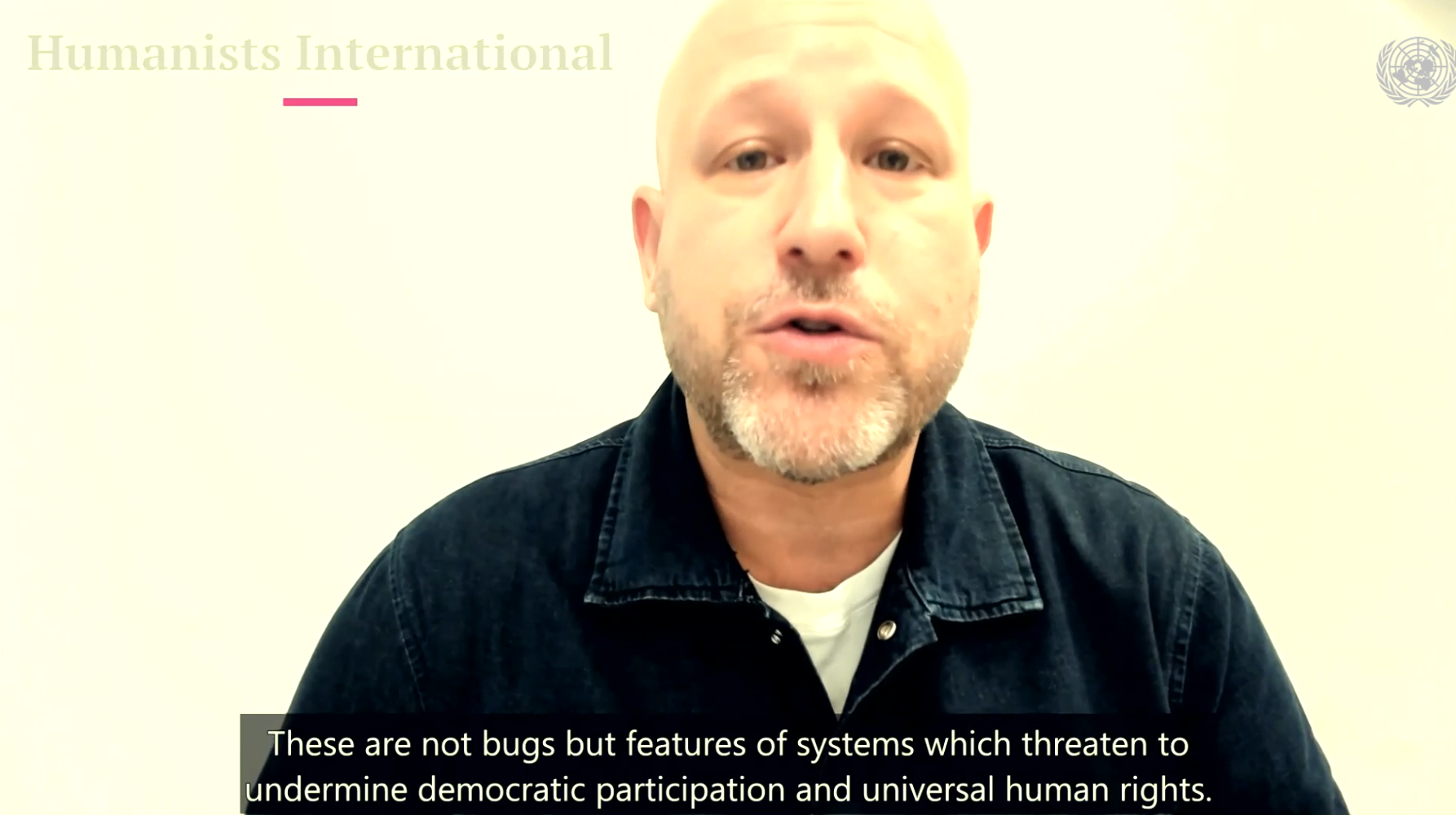
In the statement, highlighted were the concerning global trends identified in the High Commissioner’s report, including the use of period-tracking and health data to criminalize women for exercising their reproductive rights, and the deployment of algorithmic systems that target minorities through a variety of worrying mechanisms, including predictive policing and the denial of social benefits.
The statement also underscored the risks posed to civic space, with minorities’ voices being silenced online even as incitement and hate speech are amplified algorithmically. Human rights defenders, Epstein noted, are increasingly targeted under restrictive laws – particularly blasphemy laws and misused counterterrorism measures, both of which violate international legal standards.
“These are not bugs but rather features of systems which threaten to undermine democratic participation and universal human rights,” Epstein said. “Technology must support human freedom, not restrict it.”
Together we can do even more to promote humanist values and defend human rights. Join Humanists International as a Member Organization or become an individual supporter in your own right.