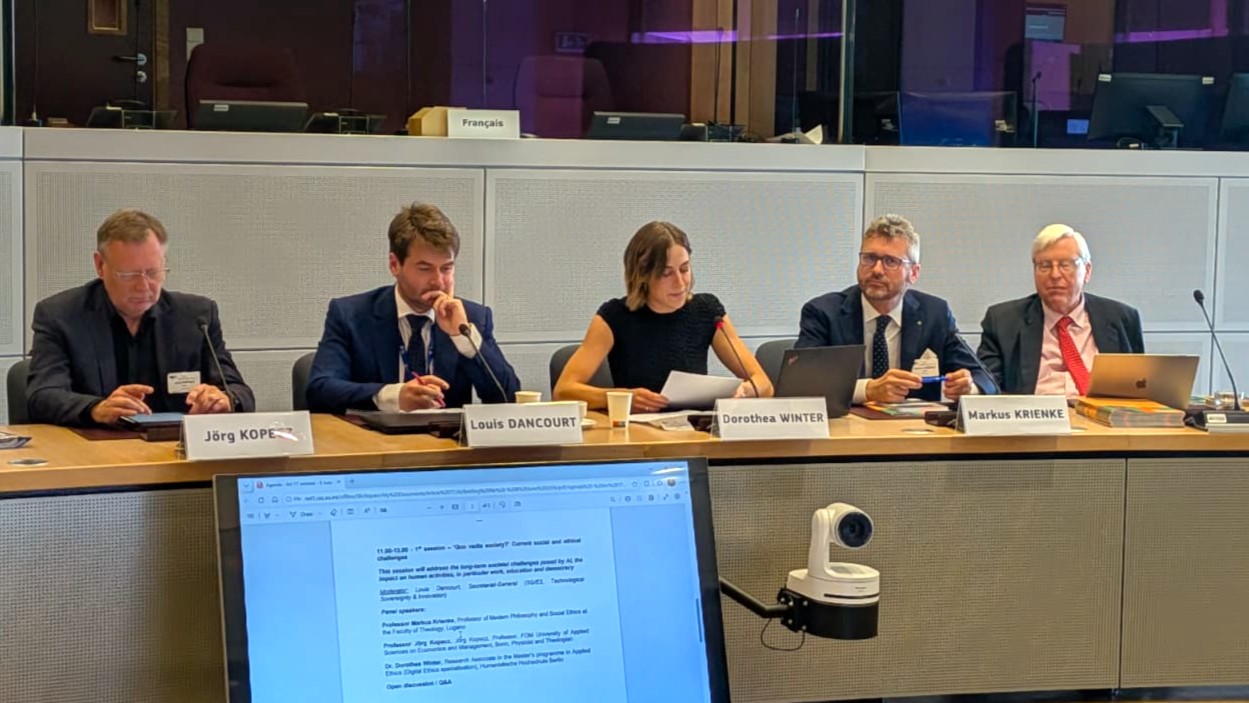
The intervention was delivered by Dr. Dorothea Winter, Research Associate in Applied Ethics at the Humanist University Berlin, on 8 June at the European Commission’s Article 17 dialogue seminar on “The ethical and social impact of artificial intelligence” after being nominated as a representative by Humanists International.
Speaking during a session on current social and ethical challenges, Dr. Winter cautioned that, without strong humanist anchors, Europe risks sliding into an economic order where a small number of foreign corporations hold the power to shape what counts as knowledge while extracting commercial rent from European data. Under this dynamic she termed “AI neocolonialism” European citizens are being treated as transparent consumers and raw material for AI development rather than as reasoning subjects of free judgment.
In that context, she outlined key tenets of the digital humanism framework. First, AI should be seen as a tool where specific systems produce specific effects and risks, rather than falling into the trap of grand narratives. Secondly, AI must be viewed as a system of selection that opaquely decides which narratives to amplify and which to suppress, shaped by its data, its engineers, and commercial interests. Finally, as AI diffuses responsibility for decisions taken, digital humanism insists that there must be a human accountable for every consequential decision an AI system takes.

Dr. Dorothea Winter, Humanist University Berlin
Dr. Winter criticized proposed EU legislation in that regard:
Where the AI Act and the GDPR treat the human being as the subject of judgement, the Omnibus treats the human being as raw material for AI development. The right to a named, accountable decision-maker is the constitutive feature of democratic governance under conditions of automation, and no simplification package should erase it.
To counter the ongoing concentration of power in the AI sphere, she presented three concrete demands for European policymakers:
The dialogue seminar featured opening remarks by Commissioner Magnus Brunner and Lucilla Sioli, Director of the EU AI Office, and featured senior EU officials and experts nominated by religious and non-confessional organizations to discuss the long-term societal challenges posed by AI. The Article 17 dialogue forms part of the European Commission’s formal engagement with religious and non-confessional organizations under Article 17 of the Treaty on the Functioning of the European Union.
Portrait photo: © Konstantin Börner
As a registered charity and NGO, we rely on the donations we receive from our members and supporters to help us campaign on humanist issues and lobby for humanist values at international institutions (including the United Nations). If you support our aims, please consider giving a one-off or regular gift today. Thank you.