
The statement was delivered in French by Thomas Gillet, President of the Centre d’Action Laïque (CAL), during a high-level panel discussion marking the fifteenth anniversary of the UN Declaration on Human Rights Education and Training. The CAL is a Member Organization of Humanists International in Belgium.
Humanists International and the CAL’s statement began from the first article of the Universal Declaration of Human Rights, which grounds human rights in the dignity and equal worth of every individual and in the fact that all human beings are “endowed with reason and conscience”. Rights therefore flow from our humanity itself, the statement argued, and not from revelation or from belonging to a particular group. The Universal Declaration calls on everyone to promote respect for human rights through teaching and education, and the 2011 Declaration on Human Rights Education requires that such education rest on the principles of equality, human dignity, openness to all, and non-discrimination.
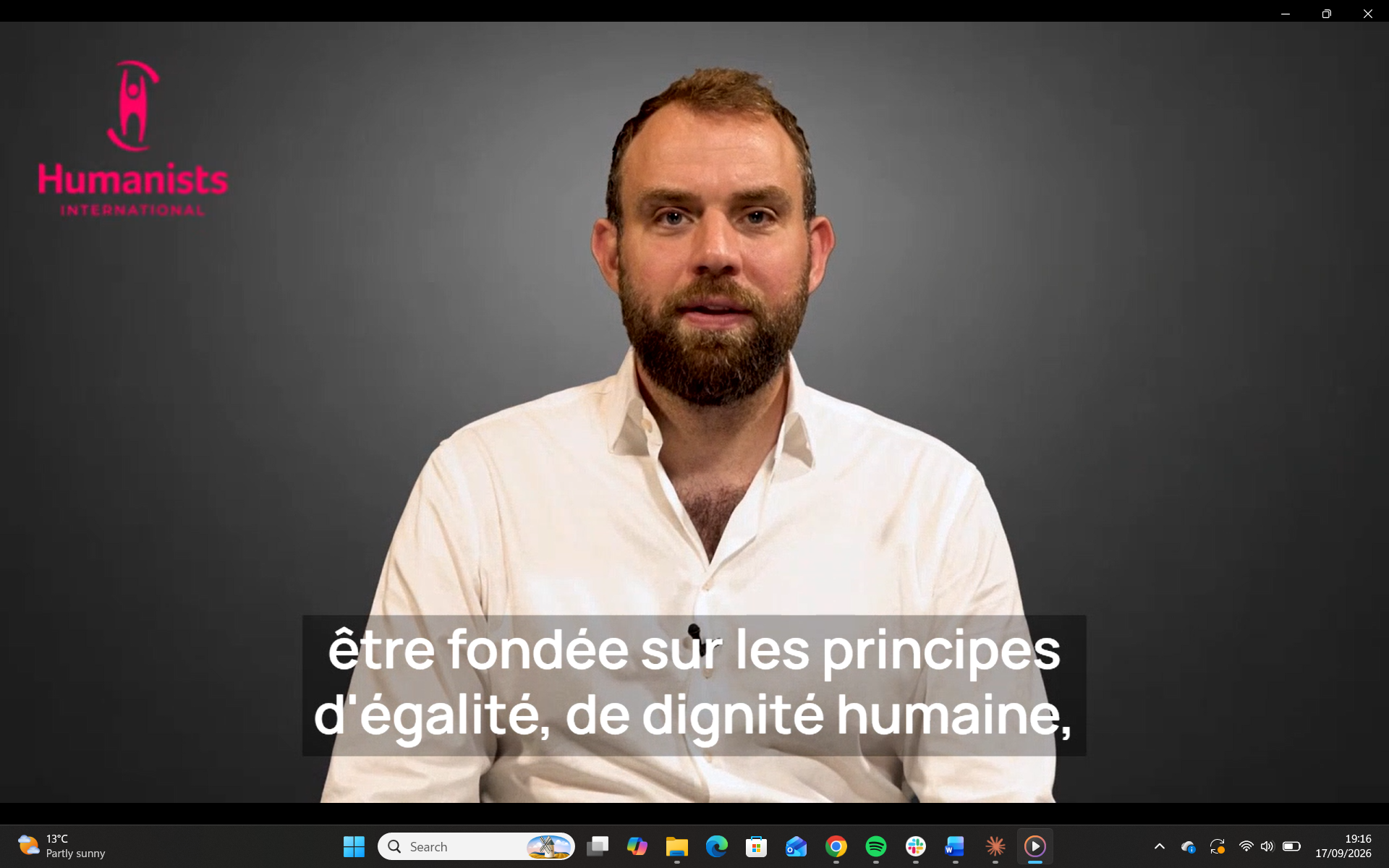
Thomas Gillet delivers the statement by video
The CAL has worked on this issue in Belgium for many years. In 2010, the CAL brought together various associations of teachers, parents, school principals, organizing authorities, federated within the Centre for the Study and Defense of Public Education (CEDEP), to demand the implementation of a course in philosophical, ethical, and civic education intended for all students. As of a decision of the Constitutional Court in 2015, and implemented across 2016 and 2017, a decree of the Parliament of the French Community in Belgium instituted one hour of philosophy and citizenship lessons for all students, and an optional additional hour for those who do not wish to take religion or ethics classes. The CAL continues to prioritize the introduction of a common 2-hour philosophy and citizenship course.
Beyond Belgium, the CAL responded to the call for input on the agenda of the sixth session of the Forum on Human Rights, Democracy and the Rule of Law, which meets at the Palais des Nations on 16 and 17 November 2026 on the theme of education for civic participation, empowering future generations, and fostering knowledge and critical thinking, encouraging the Forum to examine this issue.
The United Nations Declaration on Human Rights Education and Training was adopted by the General Assembly on 19 December 2011 by resolution 66/137. It affirms that everyone has the right to know about human rights, and sets out the responsibilities of States for education and training that are based on the principles of equality and non-discrimination. The Declaration is not legally binding, but it provides an agreed standard against which national practice can be measured.
As a registered charity and NGO, we rely on the donations we receive from our members and supporters to help us campaign on humanist issues and lobby for humanist values at international institutions (including the United Nations). If you support our aims, please consider giving a one-off or regular gift today. Thank you.