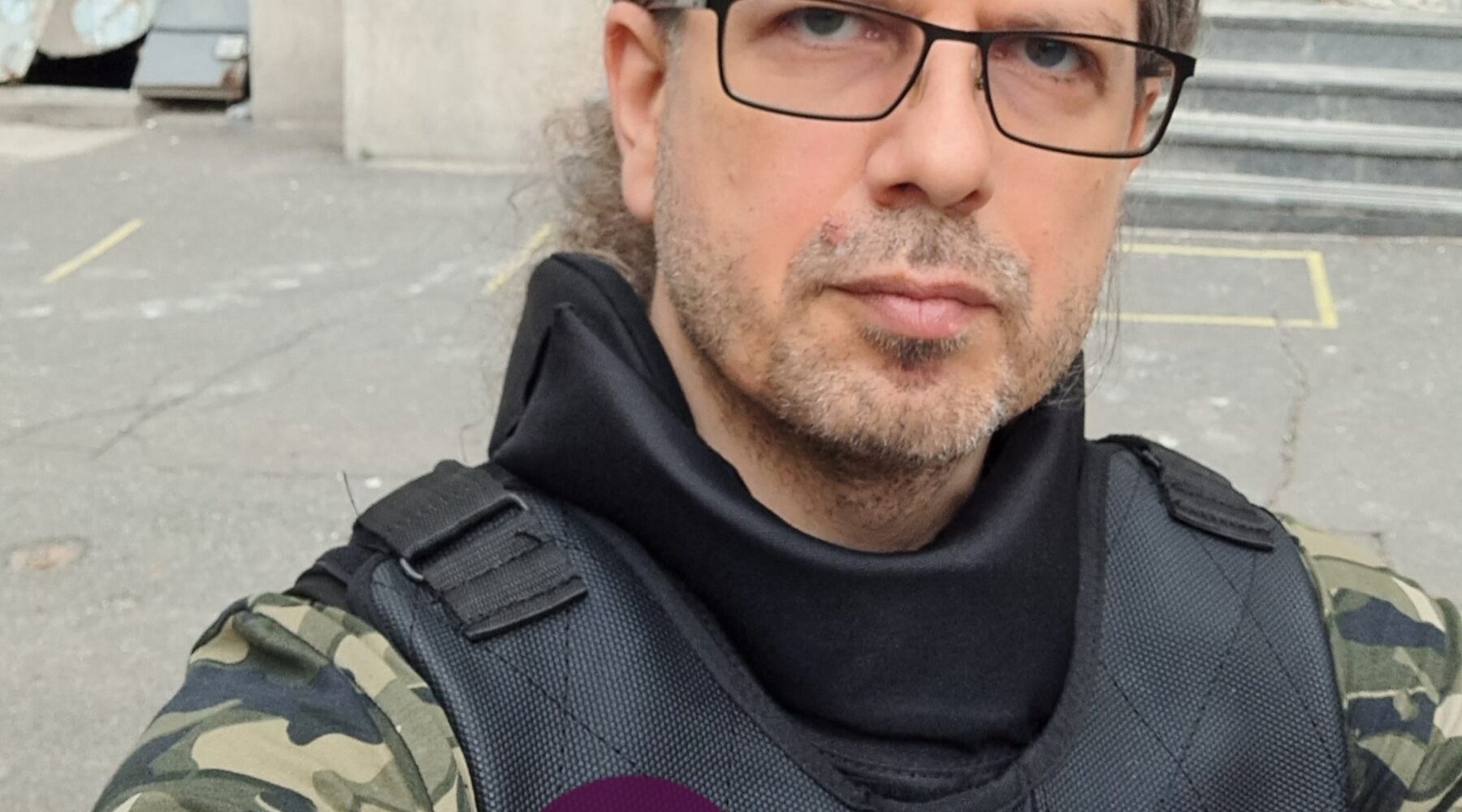
Humanism Under Fire: Remus Cernea on Ukraine, War, and Moral Responsibility
When philosophy collides with air-raid sirens, abstraction falls away. Scott Douglas Jacobsen revisits his first meeting with Remus Cernea.
When philosophy collides with air-raid sirens, abstraction falls away. Scott Douglas Jacobsen revisits his first meeting with Remus Cernea.

Image credit: Scott Jacobsen.
Scott Douglas Jacobsen is the publisher of In-Sight Publishing (ISBN: 978-1-0692343) and Editor-in-Chief of In-Sight: Interviews (ISSN: 2369-6885). He writes for The Good Men Project, The Humanist, International Policy Digest (ISSN: 2332-9416), Basic Income Earth Network (UK Registered Charity 1177066), A Further Inquiry, and other media. He is a member in good standing of numerous media organizations.
Author Disclaimer
The views and opinions expressed in this article are solely those of the author and do not necessarily reflect the official policy or position of any organization, institution, or entity with which the author may be affiliated, including Humanists International.
Remus Cernea is a Romanian human rights, secular, and environmental advocate who served in Romania’s Chamber of Deputies from 2012 to 2016. A former leader in the Green political movement, he ran for president in 2009 and co-founded in 2003 the Solidarity for Freedom of Conscience, the first Romanian civil society group promoting the separation of church and state. In 2008 he founded the Romanian Humanist Association where he was its president between 2008-2012, and in 2013 the General Assembly of the Humanist International was organized by RHA in Bucharest, Romania. Beyond politics ans secularism, he has campaigned for animal welfare and sustainable development, and in recent years has reported from Ukraine, documenting civilian resilience under attack. Trained in philosophy, Cernea brings a values-forward, pro-democracy lens to public debates, arguing for Western solidarity with people resisting authoritarian aggression.
In this interview, Scott Douglas Jacobsen speaks with Remus Cernea, Romanian humanist, former parliamentarian, and on-the-ground war reporter in Ukraine. Cernea explains why philosophy compelled him to experience war directly, arguing that truth, justice, and moral clarity cannot be grasped at a distance. Drawing parallels between Ukraine’s war and Europe’s twentieth-century catastrophes, he warns that international institutions meant to prevent conflict are failing. For humanists, he argues, war offers a grim lesson: values without defense are hollow. Humanism demands not martyrdom or fanaticism, but the willingness to protect innocent lives against authoritarian violence.
Scott Douglas Jacobsen: We met in Copenhagen at the Humanist International General Assembly. You were a keynote speaker, I interviewed you, and you suggested, “Why don’t you come to Ukraine with me?” I said, “That is insane. Let us do it.” I always tell whoever I talk to, at whatever conference, when they ask why I am doing this, that I blame a Romanian humanist, Remus Cernea, and a Ukrainian human rights activist, now prominent and internationally recognized, Oleksandra Romantsova. Romanian and Ukrainian are the reasons why I am still doing this. I said I would keep doing these interviews until it is over. They are still at war, so here we are. You have many skills, talents, and networks. You could be doing cozier things than going to a war zone. What is the humanistic impulse behind covering the war in Ukraine on the ground?
Remus Cernea: War is connected to the most philosophical fields. I studied philosophy. I am interested in political philosophy, epistemology, and many other intellectual disciplines. War is related to the problems of truth, justice, politics, and the meaning of life. For me, the primary motivation for spending a long time in Ukraine was to see and understand what is happening there, not only intellectually but also organically, through lived experience and feelings. This motivation was philosophical, but philosophy combined with emotions. When you hear air raid alarms, listen to explosions, and see people killed by Russian missiles or drones, you gain another dimension of understanding that cannot come from reading books, watching documentaries, or attending conferences about war, important as those are. It was essential for me to plunge into a war, to understand it with my senses and emotions, not only with my intellect. It was also a gesture of solidarity with the people of Ukraine who are living through this hell, which is this war. When we first met in 2023, I did not think the war would last so long.
The full-scale Russian invasion that began on February 24, 2022, will enter its fifth year in February 2026. It has already lasted longer than the Second World War did for some countries. Romania entered the Second World War in June 1941, changed sides in August 1944, and fighting ended in May 1945, less than four years. In this sense, the war in Ukraine is approaching, or has already exceeded, the length of the Second World War as a lived experience. In a way, it has become my Second World War. I was deeply struck when I found a family photograph of my grandfather, an officer in the Romanian army during the Second World War, who fought in several battles in the same regions I am visiting now. It is profoundly sad that my grandfather was forced to fight in these places eighty years ago, and that I am now returning to them as a war correspondent. History in this part of Europe is intensely dramatic and tragic.
The intensity of the war in Ukraine is already comparable, in its dramatism, intensity, and destruction, to the Second World War. For people who see it only on television or social media, they may understand or see something, but this war should never have happened. We believed that in the twenty-first century, we were wiser, more developed, and supported by international institutions capable of preventing war. We now face the reality that we have nothing effective to stop wars of this kind. History is beginning to rhyme with the 1930s of the twentieth century.
Unfortunately, there is a real risk of escalation. There is a risk of a broader war between Europe and Russia in the coming years. More and more voices are warning about this, including heads of intelligence services and high-level politicians in Germany, the United Kingdom, and other European countries. Across Europe, governments are preparing for war. Defence budgets are increasing, and countries are purchasing tanks, fighter jets, and other weapons because Russia is perceived as a significant threat. There is little trust in Vladimir Putin when he claims he is not interested in attacking Europe, because similar assurances were made shortly before the full-scale invasion of Ukraine. Russia is therefore not seen as trustworthy. It is also possible that Putin’s regime depends on war to maintain control over the population. If the war were to stop, people might begin asking difficult questions: why so many died in Ukraine, and for what purpose? A permanent state of war may serve the regime by preserving power and suppressing dissent. For the regime, war functions as a tool of political survival. The price, however, is paid by ordinary people in Ukraine and by Europeans who are supporting Ukraine and working to defend it. Because of all this, the future feels deeply uncertain, almost impossible to see clearly. I remember as a child, and later as a young person, reading science-fiction books that imagined the 2000s as a time when humanity would be colonizing Mars or cooperating to explore space. Instead, humanity is now trapped in the consequences of the war in Ukraine, whose global effects are profound.
Jacobsen: Was one of those prominent authors, the famous science-fiction writer, humanist, and former president of the American Humanist Association, Isaac Asimov?
Cernea: Isaac Asimov, Frank Herbert, and many others wrote short stories and novels imagining a future in which humanity had colonized space. Many classic science-fiction works from the 1950s, 1960s, and even the 1970s imagined that by the 2000s humans would already have colonies on Mars or the Moon. Instead, humanity is now, unfortunately, trapped in the consequences of the war in Ukraine, because those consequences are planetary. We can see that we do not have a viable international system or institutions capable of preventing war. This means that other wars can begin in many places.
Only through institutions and adherence to international principles, such as those in the UN Charter or the Helsinki Accords, which state that borders cannot be changed by force, can we hope for a peaceful future. If such principles are respected and such institutions function, peace is at least possible. At present, these structures appear to be in ruins. International institutions have lost credibility and influence, and the United Nations, whose founding purpose was to prevent war, is widely seen as unable to act effectively. If we return to periods in history without an international order or shared principles to maintain peace, when only great powers decided outcomes, we will again face the consequences that led to the First and Second World Wars.
What is happening now risks pulling the world back toward the conditions that preceded those catastrophes. The risk of a violent and bloody future is therefore high, arguably higher than at any point since 1945. Even during the Cold War, there was a form of mutual equilibrium, and neither NATO nor the Soviet Union and its allies were willing to start a direct war with each other. Today, that equilibrium appears broken. There is also concern about leadership that disregards international norms and principles, replacing them with personal, subjective judgments rather than commitments grounded in international law. Peace cannot be maintained through such an approach. In this context, the message becomes stark: freedom may once again demand sacrifice, and societies must confront that reality.
Jacobsen: What is the big lesson of war for humanists? For example, a person shaped by a martyr-based interpretation of Islam may have a radically different understanding of the purpose of war and conflict. Others may hold an honour-based Christian theology, where dying in battle is seen as an honourable path, as many believed during the Second World War. For humanists, there is no afterlife. Outside of the memory of others, there are no promises of heaven or threats of hell. Given that we have only this life to live, what is the fundamental lesson of war?
Cernea: Humanism is a movement that began in dark times, darker than those we face today. There were brave intellectuals, philosophers, and writers who risked their lives to think rationally and to write in defence of reason, against dogmas, ideologies, and powerful institutions that kept people in chains. What you said is true: fanatics of war today—whether Islamist extremists or pro-Putin fighters in Ukraine—are motivated by ideologies that justify killing innocent people. They believe this gives meaning to their lives, whether through promises of heaven, money, power, or even the pleasure of killing itself.
Humanism represents a fundamentally different approach. From a humanist perspective, one must be prepared to fight, and even to die, to protect freedom, democracy, and innocent people. Fanaticism and dark ideologies are willing to kill innocents and make that violence the purpose of their wars. Humanism, by contrast, requires education and moral clarity so that people are prepared to defend those innocent people who would otherwise be killed by fanatics, warmongers, or tyrannical regimes. To demonstrate a genuine commitment to humanist values, one must also be willing to fight and die for them. Otherwise, that commitment is incomplete. If we are unwilling to defend these values, we implicitly accept compromise and the loss of freedom in exchange for survival or some benefits. But a life lived in chains raises a fundamental question about what kind of life it truly is.
Jacobsen: Thank you for the opportunity and your time, Remus.
Photo by Remus Cernea