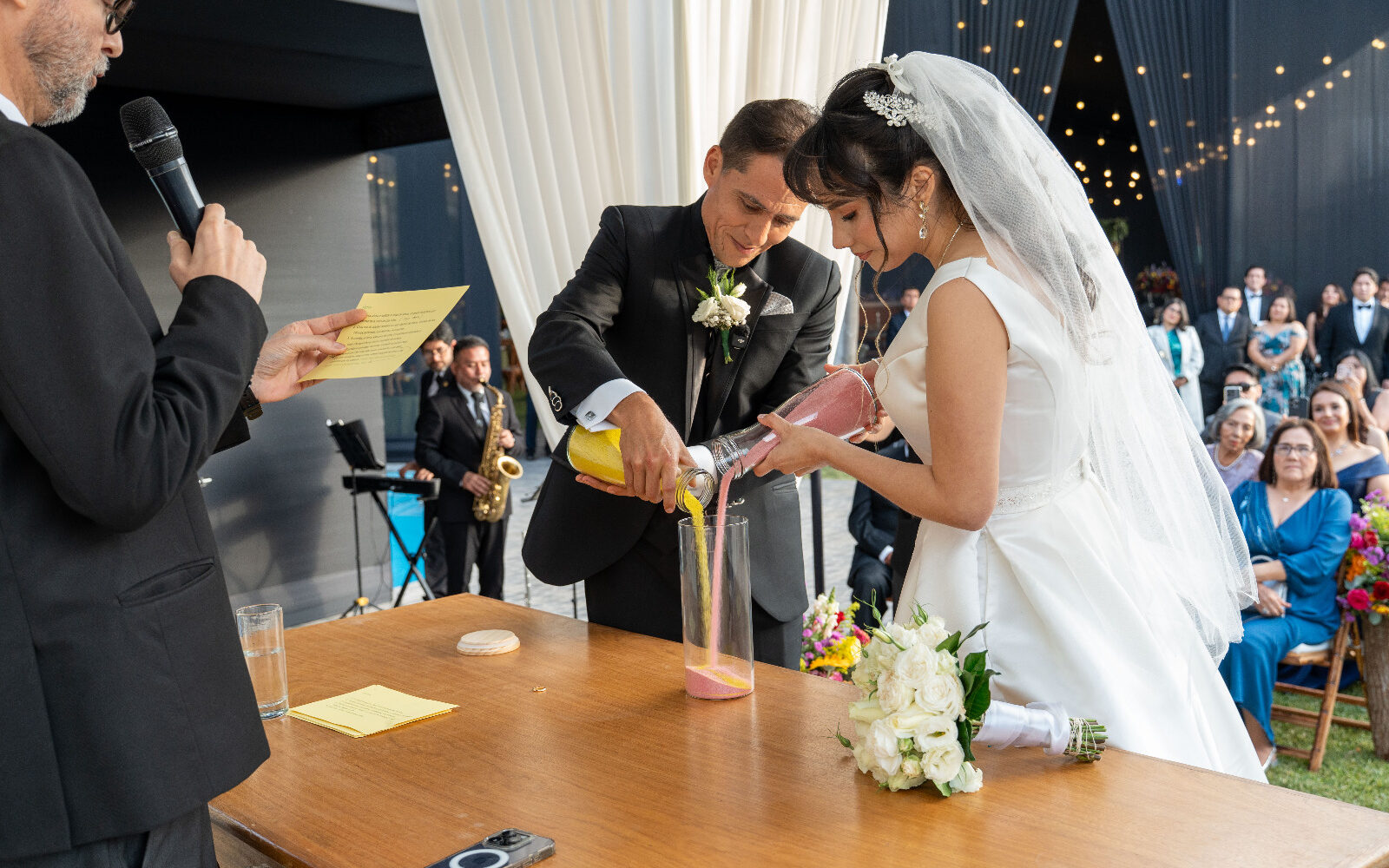
Author: Victor García-Belaunde, President of the Secular Humanist Society of Peru
On Saturday, November 8, 2025, something unprecedented occurred in a country where public rituals continue to be dominated by religious discourse and rigid civil ceremonies. That day, the first humanist wedding in Peru was celebrated in Lima—a ceremony based on universal ethical values, personal autonomy, and freedom of conscience. I had the honor of accompanying Paola Veliz, a Peruvian singer-songwriter, and Raúl Torres, director of the Secular Humanist Society of Peru (SSH), who chose this format because no existing rite authentically represented their way of seeing the world. Thus, in accordance with my duties as president of the SSH and with the help of the couple, we drafted the script for the wedding, which begins: “We are gathered by something profoundly human: the capacity of each person to give meaning to their life and to build it together… Today we celebrate precisely that: the love and commitment of two people who, in full freedom, have chosen to unite to establish a shared future.”
One of the most moving moments was the exchange of personalized vows, “commitments born from the heart, from experience, and from the desire to continue choosing each other every day.” It was mentioned that love is deeply human and is not born of perfection, but of the desire to build a path together. Carl Sagan was quoted: “Love is a way of taking care of one another in a universe that, to a large extent, is indifferent to us.”
Finally, the Sand Ritual was performed, representing union without individual renunciation: “Each of you holds a different color of sand, a symbol of your personal paths: your stories and your dreams. By pouring them together into this glass urn, the colors intertwine and create a new shape, unique and impossible to separate.” Unlike pre-established ceremonies, a humanist wedding is designed alongside the couple, who choose their rituals, incorporating their history and their values.
This first humanist wedding marks the beginning of a practice that is only now finding a place in Peru, offering non-believing couples for the first time a symbolic and personalized alternative to affirm their commitment without the need to resort to denominational institutions or limit themselves solely to a municipal ceremony of an administrative nature.
However, humanist weddings did not originate here, but rather more than a century ago. The first documented symbolic wedding was performed by the Union of Ethical Societies in 1899 in London. Its purpose was to create rites based on shared human values rather than supernatural doctrines. Over time, these ceremonies multiplied until reaching a historic recognition in Scotland, where on June 18, 2005, the first humanist wedding with legal validity was celebrated, paving the way for thousands of official marriages in Ireland, Norway, Iceland, and regions of the United States.
In Peru, humanist ceremonies are conspicuous by their absence. We are a nation where freedom of belief is constitutionally protected, yet the symbolic options for celebrating love remain restricted to two formats: one religious and the other strictly civil. Administrative marriage generates legal validity but lacks human depth. The religious ceremony offers solemnity but is inadequate for the four million [1] Peruvians without religious affiliation.
The humanist wedding seeks to fill that void. It does not intend to replace civil marriage or compete with religious traditions; rather, it affirms that diversity is a right, not a threat. The discussion is not legal. Civil marriage will continue to be the legal route. The discussion is cultural and democratic: recognizing that agnostic and atheistic people have the right to celebrate their lives according to their values.
Peru has opened a door. Now it is up to us not to close it. If we aspire to a plural and modern society, we must admit that human life is richer than any dogma. Love between non-believers deserves to be celebrated from reason, equality, and mutual respect. Because a mature democracy is not measured by how many people think alike, but by how free those who think differently are.
[1] According to a survey by the Institute of Peruvian Studies (IEP) conducted in 2024.