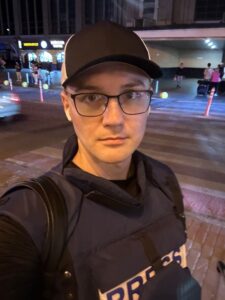
Image credit: Scott Jacobsen.
Scott Douglas Jacobsen is the publisher of In-Sight Publishing (ISBN: 978-1-0692343) and Editor-in-Chief of In-Sight: Interviews (ISSN: 2369-6885). He writes for The Good Men Project, The Humanist, International Policy Digest (ISSN: 2332-9416), Basic Income Earth Network (UK Registered Charity 1177066), A Further Inquiry, and other media. He is a member in good standing of numerous media organizations.
Author Disclaimer
The views and opinions expressed in this article are solely those of the author and do not necessarily reflect the official policy or position of any organization, institution, or entity with which the author may be affiliated, including Humanists International.
Diego Vargas, Project Manager of the Oniros Philosophie Foundation, discusses religious influence in Bogotá and Colombia. The Catholic Church illegally occupies public spaces, while Mennonite groups encroach on indigenous lands in Meta. Religious influence has shaped Colombia’s politics, with a history of church-led violence and right-wing dominance. The church also controls education, suppressing critical thinking. Apostasy faces bureaucratic barriers, with institutions favoring religious entities. Minority groups like LGBTI, Afro-descendants, and feminists often neglect secular activism. Vargas urges co-responsibility among these groups to counter religious dominance, emphasizing secularism’s role in defending human rights and social justice in Colombia.
Scott Douglas Jacobsen: Today, we are here with Diego Vargas, the Project Manager of the Oniros Philosophie Foundation (Fundación Oniros Philosophie), out of Bogotá. Let’s talk about the issues targeted by OPF/FOP: How has the Catholic Church in Bogotá asserted itself into public spaces?
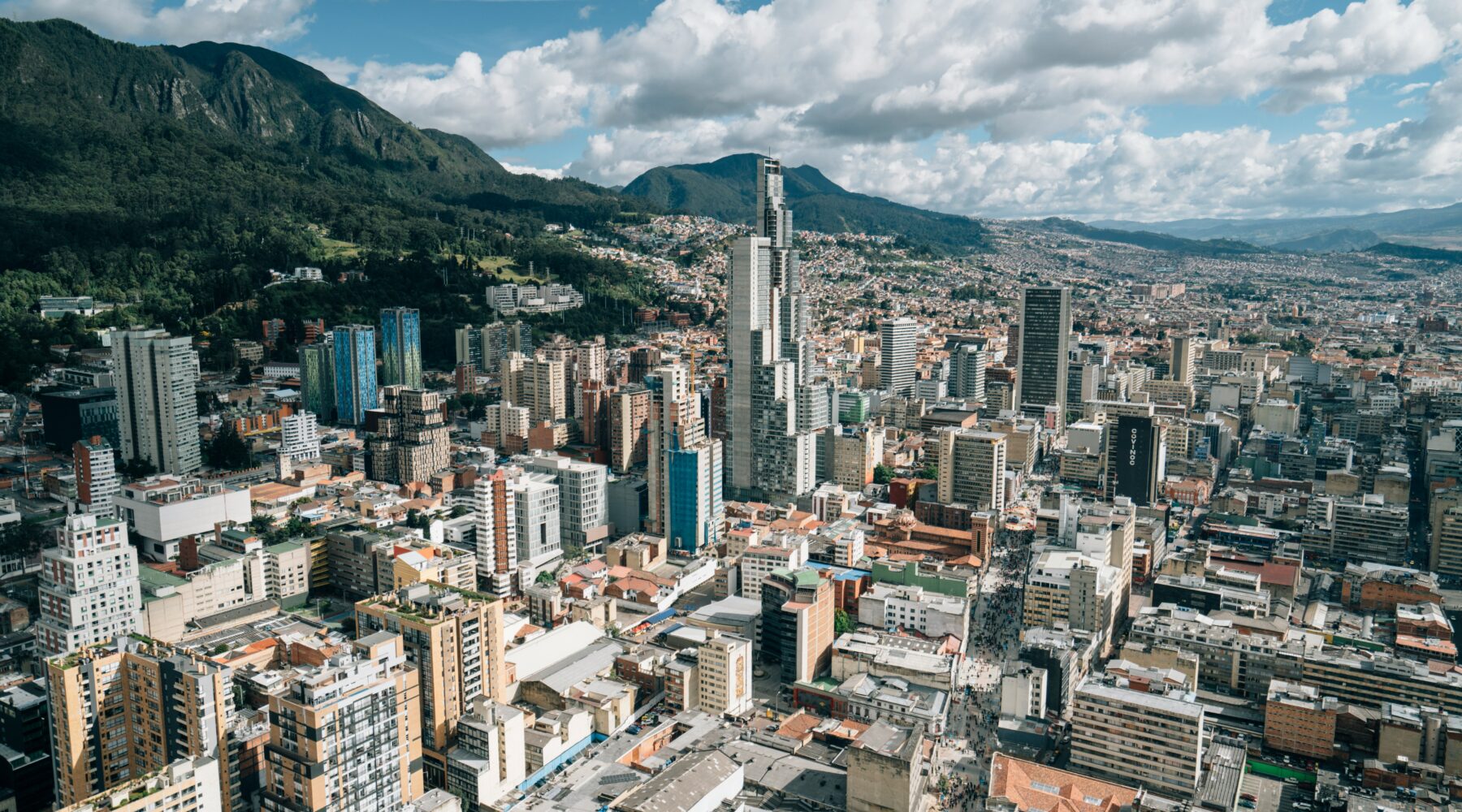
Diego A. Vargas: Despite the fact that the Political Constitution of Colombia of 1991 stipulates in article 63 that goods for public use are inalienable, imprescriptible and cannot be seized; The truth is that in the city of Bogotá alone there are 210 invasions of public spaces in parks, avenues and green areas.
The invasion dynamic they practice is that the diocese assigns a priest to a neighborhood without a church, and when he arrives in said neighborhood, he builds an illegal settlement without permits with sticks and boards, zinc tiles and polyshade; It must be clarified that this settlement has an illegal or pirate connection to the electricity service. And although there is an entity whose mission is to defend public space, called the Administrative Department for the Defense of Public Space (DADEP), neither this entity nor the mayor’s office apply the Law to recover public space.
People already assume and affirm that religion, and especially the Catholic Church, is above the Law, so much so that they do not pay any type of tax, much less property tax for land that was stolen.
Jacobsen: What practices by Mennonite groups in Meta are encroaching on public spaces?
Vargas: In recent years, Mennonite groups, coming mainly from the United States, have launched a colonialist invasion in the region of the eastern Colombian plains, and more specifically in the department of Meta. Since they have invaded lands, displaced indigenous communities, stolen lands using the legal loophole of “purchasing” under the figure of “third party in good faith”, and finally they are generating a problem of deforestation in the Colombian Orinoquía region.
All of this is, of course, part of the new forms of coloniality of power through the evangelical Christian religion, which at the time was denounced by the Latin American and of course South American thinker Enrique Dussel.
Jacobsen: How has the Catholic Church shaped political decision-making in Colombia?
Vargas: From 1886 to 1990, a theocratic, right-wing, conservative, anti-scientific and anti-progressive Political Constitution was implemented in Colombia; This meant that, for example, the country was consecrated to the “sacred heart of Jesus”, and even today a debt is being paid in perpetuity to the Vatican because during the mid-19th century a liberal government had expelled the Jesuit order from the country, annulling a previous concordat that was in effect during the mid-19th century and had expropriated assets from the unproductive hands of the church. And from that moment on, the dominance of the Catholic religion in politics was total; with a constitution that invoked and invokes God for everything, then the president attends a Tedeum when he takes office, if peace talks are going to be held with armed groups, the middle person is the church, in the history of Colombia there has only been one candidate atheist, the late Carlos Gaviria Díaz, who precisely lost the 2006 elections for having declared himself an atheist, and thus there are many things that define the dominance and interference of religion over politics since in each church, Catholic or evangelical, political proselytism is carried out, and in every hamlet, town, district or village there is a church, and since religion is right-wing, the right has always won and “demonizes” left-wing candidates by saying that they are atheists, so it took 157 years for the country to once again have a left-wing president who at least knows how to pronounce the word secularity; And all those years are the window of time that passed between the presidency of Tomás Cipriano de Mosquera and that of the current president of the republic Gustavo Petro Urrego.
Jacobsen: What are examples of how religious institutions have been connected with violence or paramilitarism in Colombian history?
Vargas: Since the creation of the Republic of Colombia, and only in the 19th century, religion caused 3 civil wars in which children were even used as soldiers: 1) The war of the convents or the supreme ones from 1839 to 1842, 2) The war of the schools from 1876 to 1877, 3) The war of a thousand days and the conservative regeneration from 1899 to 1902
But the issue does not stop there, since, in 2016, and with the sponsorship of the University of Berkeley, the Truth Commission generated an investigative and historical document on Human Rights called: “Cases of involvement of the church in the violence in Colombia – Input for the commission to clarify the truth”, and in said document 62 cases of violence caused by the Catholic Church between the 19th and 20th centuries are reported, apart from the 3 wars caused in the century XIX.
The most representative cases are encyclicals from the 19th century that invited liberals, Freemasons, socialists and atheists to be killed, under the declaration that killing these people was not a sin; For the 20th century, it is worth highlighting the preaching that generated bipartisan violence in which conservative believers killed liberals under the accusation of being atheists, also the formation of armed groups called “chulavitas”, then the formation of paramilitary groups with a religious vocation called “ the 12 apostles” and currently the presence of evangelical pastors who launder money from drug trafficking, among many other things that have caused alterity and difference to be annulled for those who They do not believe or practice a religion.
Jacobsen: How does the dominance of religious doctrine manifest in Colombian educational institutions?
Vargas: It happens that the Political Constitution of Colombia of 1991 indicates in its article 68 that in the educational establishments of the state no person will be forced to receive religious education, but in the General Law of Education (115 of 1994) stipulates in its article 23 that religion It is a mandatory and fundamental area of teaching, especially in State educational establishments. So although this is a contradiction and a clear violation of the Constitution, it is just the tip of the iceberg, because other things that show this predominance are that there are private administrators who have public schools under concession and in the city of Bogotá D.C., 80% of These are entities of the religious sector, the majority of universities in the private sector are Catholic and ultimately when we talk about religion classes we do not talk about the more than 4,200 existing religions and others that no longer exist, but rather that we only talk about teaching a religion, and this is the Catholic religion, so this teaching of religion is nothing more than a teaching of religious and right-wing indoctrination that expands in public and private education and that promotes discrimination. towards difference and otherness, the rejection of equity and of course trampling on progressive values and social justice.
Jacobsen: What effects might a single-religion focus in schools have on critical thinking among students?
Vargas: It has had negative effects, since students do not have the possibility of choosing and only know one religion, and this indoctrinates them towards right-wing thinking that does not contemplate diversity, difference, otherness and much less the multicultural and multi-ethnic character that enshrines the Political Constitution of Colombia of 1991 and even less Human Rights. So, if you talk about Yoruba religion and Orisha gods, society says that this is witchcraft and satanism, if you talk about indigenous spirituality, it is also demonized, if you talk about paganism they are ready to light the bonfire. So, the boys have no information or reference point to compare between religions, the monopoly that religion has in power, education and politics, and since they cannot compare with anything, they cannot reflect or criticize, and their thinking ends up being right-wing, submissive, doctrinaire and they replicate all of this with those around them.
Jacobsen: What administrative barriers do Colombians encounter when apostatizing from a religion?
Vargas: Well, it happens that the Catholic Church has a chancery for these issues, and at the beginning if people do not have knowledge of legal activism and strategic litigation they make them understand that they cannot apostatize, but if the person crosses that barrier they must overcome the fact that a city can be divided into up to 5 dioceses that depend on an archdiocese for land issues but not for administrative issues such as apostasy, then there is the problem that if the person was baptized far from a city capital, that is, in a town, you must go to that place to request the baptism certificate and then to verify that the footnote is made in the baptism books so that the apostasy becomes effective; There is also the inconvenience that they try to persuade the person who is trying to file his apostasy and subject him to a kind of uncomfortable “conversation” within a church and finally there is no formal certificate that shows whether the apostasy was effective, because they only give a generic answer using a template that says that the note of the apostasy was made in the baptism book and therefore you have to go to the parish in which the baptism was done to find out if it is true on a trip that It can be 2 hours a day and a half.
Jacobsen: How do religious organizations justify bureaucratic barriers?
Vargas: Well, neither the Ministry of the Interior nor the National Administrative Department of Statistics of Colombia (DANE) enforce the Law, nor the Human Rights regarding freedom and conscientious objection nor legal personality, since the first of these do not have this service of apostasy included within their services or procedures, but rather the service of linking Religious Entities and Organizations of the Religious Sector to monopolize Human Rights projects and the hoarding of resources and public money. And in the case of DANE, they consider religion as something sacred and untouchable and for that reason they never include in the censuses a question about religious affiliation that would undoubtedly open the debate on freedom of conscience and apostasy.
Jacobsen: Why are minority groups such as LGBTI, Afro-descendants, indigenous, and feminists seen as fracturing broader secular activism efforts?
Vargas: This has occurred because the differential and rights-based approach has been transformed into a preferential and fascist approach, this is because there are many people in public life who belong to the LGBTI community and are right-wing and fascist (uribistas); In Bogotá D.C., we had a lesbian and right-wing mayor who ordered the police to beat women, there is also a representative of the chamber (bicameral congress of Colombia) who is homosexual and Afro-descendant, but who at the same time denies the massacres, forced displacements and extrajudicial executions in the government of former president Álvaro Uribe and labels left-wing people as guerrillas, but the irony is that these two characters totally believers.
There is another group of academic feminists who constantly attack figures in left-wing public and political life who fight to defend the rights of the population, but they never speak or defend secularism, and they have never supported bills that seek to make churches pay taxes. And in short, both feminism and the LGBTI community in Colombia are apathetic regarding the defense of secularism and expect us atheists to attend their marches, but they never support either the legal and constitutional actions or the sit-ins or marches that we atheists call for; So in short, it is a toxic and harmful relationship that does not respond with co-responsibility towards secularism, and on the contrary they make us look bad because the only activism they do is paint a church with graffiti while showing their breasts or throw Molotov cocktails at their doors without it being clear to public opinion why they do it, and it ends up generating the generalized opinion that those of us who are not linked to any church are almost vandals.
Jacobsen: What strategies can secular activists employ to foster productive collaboration with LGBTI, Afro-descendant, indigenous, and feminist groups to strengthen the secular movement?
Vargas: First of all, there must be co-responsibility and equitable cooperation between these social movements and the fight for secularism, and for this the LGBTI community must stop seeking acceptance in a conservative society that will never fully admit them even though they want to show fascist behavior; Afro-descendants would have to understand that Christianity was the godfather of slavery and include secularism within the themes of the African diaspora, or at least return to its roots in the Yoruba religion; The indigenous people must take into account that indigenous spirituality no longer exists and now, through syncretism, they ended up being evangelical natives and finally, feminists must support freedom more and not conservatively judge other women who are not feminists or excluding men from gender issues without understanding that this does not solve anything but analyze that religion is the cause of historical and current violence against women.
Jacobsen: Thank you for the opportunity and your time, Diego.
Photo by Random Institute on Unsplash