 Leslie Allan is an Australian philosopher whose work examines the intellectual foundations of humanism, secular ethics and Enlightenment thought. He studied history and philosophy at La Trobe University, where he received the David Hume Prize. He is a Non-Executive Director of Humanists Australia and founder of the Ex-Religious Support
Network. His work is published at RationalRealm.com.
Disclaimer: The views expressed in this article are those of the contributor and do not necessarily reflect the views of Humanists International.
Through my involvement with humanist and secular organizations in Australia, I have long been interested in strengthening public understanding of humanism and humanist ethics. I was therefore concerned when I encountered Yuval Noah Harari’s portrayal of humanism in his international bestsellers Sapiens and Homo Deus.
Harari presents humanism as a religion that treats humanity as sacred, claiming its competing forms—liberal, socialist and evolutionary humanism—gave rise to some of the most destructive ideologies and conflicts of the modern era. He describes humanism as a “natural-law religion” and attributes the “bloodiest wars of religion in history” to its competing sects.
Drawing on my background in history and philosophy, I could see that something was seriously wrong with this account. What began as a brief check of his historical claims turned into a year-long examination of the intellectual and historical sources on which Harari’s work rests.
What I found was not just an over-simplified history. Harari repeatedly misrepresents the origins, meanings and development of humanism—sometimes turning the historical record on its head. Key figures and movements are assigned to categories in ways that obscure, and all too often reverse, their actual intellectual commitments and historical relationships.
One of the most striking examples concerns Harari’s adoption of the term, “evolutionary humanism”. He associates it with Hitler and Nazi ideology. Yet the term itself was coined by Julian Huxley after the Second World War as part of an explicitly humanist response to fascism and racism. Likewise, Harari associates “socialist humanism” with Stalin’s brutal repression. Contra Harari, the label was adopted in the 1950s and 60s by dissidents pushing back against Stalinism. They were among the Soviet system’s sharpest critics. Harari has these movements at war under banners nobody had yet sewn.
My book examines these errors in detail and offers an alternative account of humanism: one rooted in rational inquiry, democratic values, human dignity and human flourishing without recourse to supernatural authority. Why does this matter to humanists today? First, historical accuracy matters for advocacy. If humanism is portrayed as an ideology responsible for Nazism, Stalinism and exploitative capitalism, explaining what humanism actually stands for and why its ethical commitments matter in public life becomes far more difficult.
Second, and more seriously, such portrayals can contribute to the vilification of humanists. The danger was put to Harari directly in Free Inquiry in 2018, when A. P. Norman asked what would follow if his characterizations of humanism were to inspire “Mao-style thought reform, humanist witch-hunts, or intellectual purges in the West”. Such concerns are not merely hypothetical. Humanists have long faced such rhetoric from religious opponents. Influential Christian evangelist Tim LaHaye had long since called for the removal of “all humanists from public office” and traced “most of the evils in the world today” to humanism.
Harari’s books have reached millions of readers in more than sixty languages. Where those accounts contain fundamental misconceptions, the errors can ripple into classrooms, media coverage and public debate. For humanists living where non-belief is already criminalised, or where humanists are cast as corrosive to the nation, a respected historian’s genealogy running from humanism to Auschwitz is not an academic quibble.
For those of us committed to reason, evidence and intellectual honesty, getting our own history right is not merely a matter of scholarship. Understanding where humanism came from is essential to explaining what humanism stands for today.
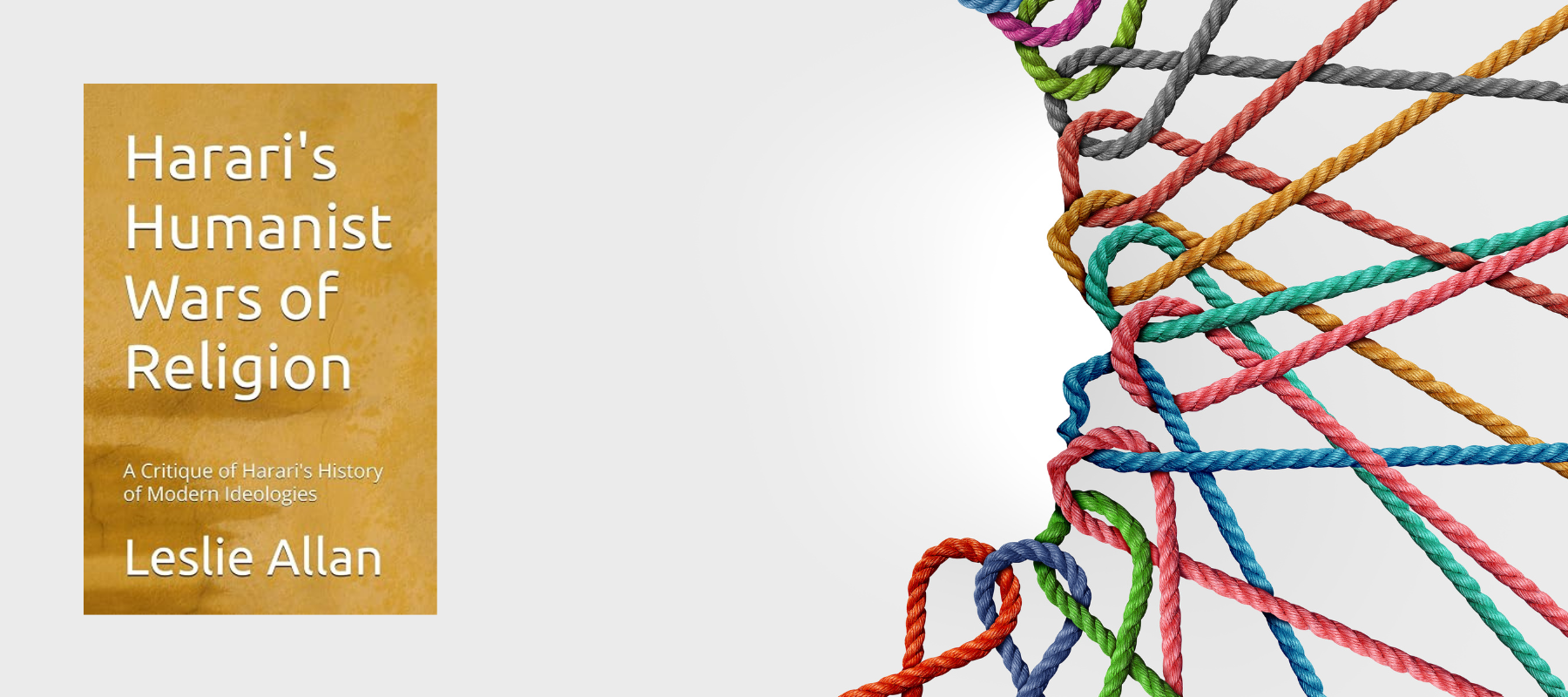
Harari’s Humanist Wars of Religion: A Critique of Harari’s History of Modern Ideologies is available worldwide in print and Kindle editions.
As a registered charity and NGO, we rely on the donations we receive from our members and supporters to help us campaign on humanist issues, lobby for humanist values at international institutions (including the United Nations) and protect humanists at risk of persecution and violence. If you support our aims, please consider giving a one-off or regular gift today. Thank you.