Adrián Núñez is a Peruvian humanist activist and the co-founder and Vice President of the Peruvian Association of Atheists (APERAT). He has also served as a Board Member of Humanists International since 2026. For over a decade, he has co-hosted a radio program dedicated to skepticism, while leading public campaigns to promote secularism and defend freedom of belief in Peru.
Disclaimer: The views expressed in this article are those of the contributor and do not necessarily reflect the views of Humanists International.
At the recent World Humanist Congress in Ottawa, I spoke with some attendees about the topic I briefly presented: how Imre Lakatos’s approach might be applied to our organizations and activities. The challenge is to find a healthy balance between encouraging diverse, even dissenting, ideas and using our limited resources to protect the “hard core” of our organizations, preventing them from drifting away from the principles of modern humanism. I felt I needed to put some of these ideas in writing for further discussion. This brief text is, in a sense, a debt I owe to those conversations, but it is also a way to reach those who could not attend the meeting.
Few things are promoted as fervently within humanism as the free discussion of ideas. Our appreciation for the diversity of views and critical thinking is perhaps our greatest strength, and the cognitive flexibility we seek to cultivate puts us in a strong position to understand the natural world, the challenges facing humanity, and possible ways of addressing them. However, our limited resources and the urgency of some of our projects should force us to make practical decisions.
In places where humanism is still relatively unknown, our organizations often attract people who share some of our perspectives, usually our criticisms of conservative institutions or traditional beliefs. Some of these people, however, do not share humanist principles. Atheist organizations attract people of very diverse backgrounds and interests, often because there are few other spaces where religion can be openly criticized. Humanism is concerned with contemporary human challenges, such as our relationship with technology, and some ideas adjacent to humanism, like transhumanism, can attract people whose worldviews don’t necessarily align with our core principles. For this reason, I believe we need something practical to bring order. An institutional defense system. Science has something similar: a mechanism that allows progress while preserving a stable framework.
The Hungarian epistemologist Imre Lakatos proposed an explanatory model of scientific research programmes (SRP). A Lakatosian research programme is built around a hard core of ideas that cannot be abandoned without effectively abandoning the programme itself, and a protective belt of auxiliary hypotheses that are subject to criticism and can be modified and adapted in response to new evidence. In this way, criticism and new evidence are primarily addressed by modifying the protective belt, allowing the hard core and the research programme as a whole to remain stable.
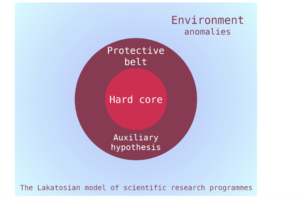
If we transfer this framework to humanist activism, we can obtain a map of how to organize our institutional discussions. If we distinguish the foundations of humanism from its auxiliary and revisable elements, the structure could look like this:
| The hard core (constitutive principles) | The protective belt (open to revision) |
| Democracy and human rights | Methods of political engagement |
| Critical thinking and scientific inquiry | Positions on scientific and technological issues |
| Secularism and separation of church and state | Responses to religious influence |
| Individual autonomy | Balancing individual rights and collective interests |
| Compassion | Strategies for reducing suffering |
| Human dignity | Approaches to inclusion and equality |
This does not mean that the hard core itself is beyond discussion. It means that abandoning it would change the identity and purpose of the organization. When individuals or groups come to embrace positions that fundamentally depart from those principles, they may be better served by finding or building an organization whose core is more consistent with their views. Organizations can evolve, but when that evolution amounts to abandoning the principles that define them, creating something new may be more honest and constructive than transforming an existing institution into something fundamentally different.
Distinguishing the organization’s foundational principles from everything secondary, auxiliary, or open to revision helps preserve its strength and resilience. When the protective belt helps the core respond to new challenges, the project remains progressive. When auxiliary ideas are modified merely to shield the core from criticism, without generating new insights or successfully addressing new challenges, the project becomes degenerative. There is another danger: the hard core itself may gradually be diluted or redefined until only the institutional shell remains. The organization may continue to exist, with its structures, programs, and public identity intact, while losing the principles that originally gave it purpose. This is another form of institutional drift: the organization continues to move, but no longer necessarily in the direction that originally gave it purpose. In Lakatosian terms, this is analogous to the degeneration of a research programme: the structure survives, but its capacity to generate meaningful progress has been lost.
For this system to work and preserve the strength and relevance of our organizations, we must take two concrete measures:
At the end of the day, our openness to debate should be the tool we use to analyze and understand the world, not the crack through which we let escape the energy, time, and resources we need to improve it.