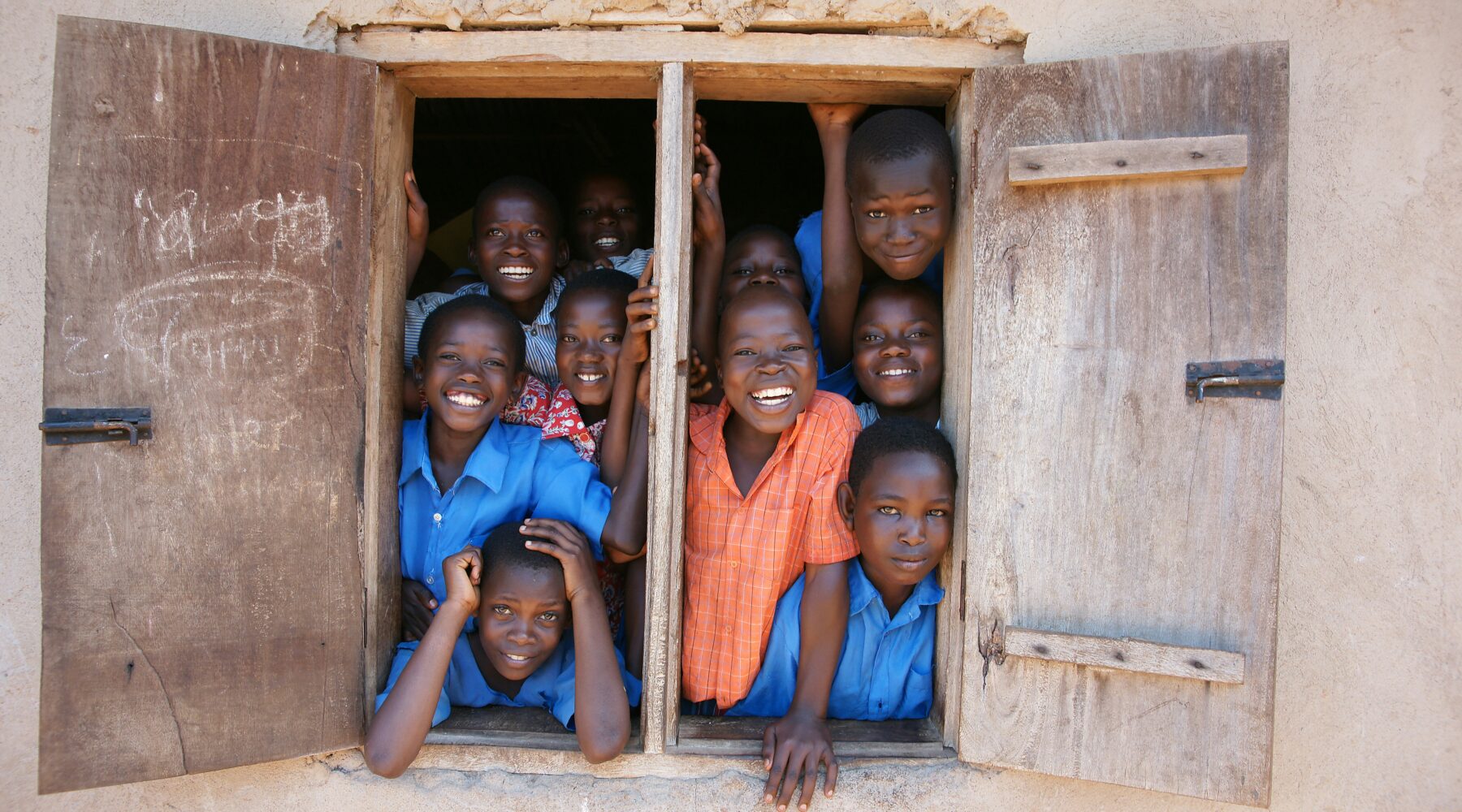
Image credit: Scott Jacobsen.
Scott Douglas Jacobsen is the publisher of In-Sight Publishing (ISBN: 978-1-0692343) and Editor-in-Chief of In-Sight: Interviews (ISSN: 2369-6885). He writes for The Good Men Project, The Humanist, International Policy Digest (ISSN: 2332-9416), Basic Income Earth Network (UK Registered Charity 1177066), A Further Inquiry, and other media. He is a member in good standing of numerous media organizations.
Author Disclaimer
The views and opinions expressed in this article are solely those of the author and do not necessarily reflect the official policy or position of any organization, institution, or entity with which the author may be affiliated, including Humanists International.
Masereka Solomon talks about Abrimac Secular Services, a secular organization dedicated to education and community development in Uganda.
He discusses the challenges of operating in a predominantly religious education system, the need for secular learning spaces, and the financial limitations they face. He talks about efforts to provide scholastic materials, food assistance, and critical thinking training through collaborations like one with Dr. Christopher DiCarlo. He talks about misconceptions surrounding secular education and how Abrimac continues advocating for inclusive, evidence-based learning, focusing on reducing suffering and improving access to essential educational resources.
Scott Douglas Jacobsen: What is new with Abrimac Secular Services? What is going on?
Masereka Solomon: Abrimac Secular Services is a secular organization registered as a company limited by guarantee. Our primary mission is to support education and community development by identifying challenges and proposing practical solutions. Additionally, we are educators dedicated to improving learning conditions.
Most of our members are teachers. With extensive experience in the education sector, we understand the backgrounds of the students we teach and the challenges teachers face. The issues in schools extend beyond our immediate workplaces; they are widespread across many institutions. Many students come from underprivileged backgrounds, and even teachers themselves often face financial difficulties.
Parents also struggle to provide for their children. As a result, we frequently step in to support learners who lack essential resources. For example, in a class of 50 mathematics students, only 10 may have access to a mathematical set, making effective learning difficult. Recognizing this, we organized ourselves to provide students with scholastic materials and other necessities, ensuring that more learners have what they need to succeed.
Beyond schools, Abrimac Secular Services is active in community outreach. The COVID-19 pandemic and lockdowns were tough times. Many teachers, as well as members of the broader community, lacked essential supplies like food. Movement restrictions further complicated the situation. In response, we mobilized resources and distributed food to those in need – we do manage a food bank, ensuring that support was accessible to anyone who required or asked for assistance. Abrimac is having several life saving projects, there’s also a water and soil conservation project where community members are given water tanks to trap rain water from their roofs as a way of checking soil erosion in mountainous areas and also help in having reliable clean water in homesteads – these are projects supported by private individuals and any other person is free to collaborate with us in providing a solution to world problems. We have several HIV patients who are struggling, they lack support in many ways. We reduce suffering regardless.
Jacobsen: Religion, politics, and education often intersect. Many of your educators work in challenging environments where religion is highly influential. When addressing social and educational problems, what challenges does religion create? What solutions do you propose?
Solomon: Religion plays a significant role in our society, and many educators in our network operate in environments where religious influence is strong. However, Abrimac Secular Services does not oppose religion itself; instead, we seek to address the challenges that arise when religious beliefs tend to create barriers to education and social progress.
For example, in schools like Kasese Humanist, students come from diverse religious backgrounds. Some issues we encounter include absenteeism due to religious obligations, restrictions on what can be taught in classrooms, and biases against secular education. Our approach is to promote inclusive and evidence-based learning while respecting individual beliefs.
Abrimac Secular Services remains committed to improving education, supporting teachers and students, and fostering a more equitable learning environment.
Jacobsen: What is the most important skill you teach students—critical thinking or something broader?
Solomon: Regarding critical thinking, I will share my perspective based on the environment I work in, humanist schools.
We approach critical thinking in different ways. At one point, we collaborated on a project with Dr. Christopher DiCarlo and Gail Miller once a president at AtheistAlliance International. I do not know if you are familiar with Dr. Christopher.
Jacobsen: Yes, I know him. I have interviewed him.
Solomon: I worked with him in 2017 on a critical thinking project. Through that initiative, we engaged learners and encouraged them to develop the ability to ask meaningful questions when faced with challenges, this has continued as a culture in our circles.
We emphasize inquiry-based learning, ensuring students are not discouraged from asking questions. Instead, we encourage them to engage in discussions and critical debates. We do not restrict learners from asking questions; we encourage them to pose complex, thought-provoking questions rather than just simple ones.
Jacobsen: What other collaborations have you done over the years? Not just with Christopher DiCarlo, but with others as well?
Solomon: We have had several collaborations with other individuals privately. We have engaged learners in sporting activities, acquired several sporting gears which overtime get worn out. Worked with Robert Nygren a soccer coach from Sweden, have worked late Mac Hoban from Austria on different projects, worked with Breanna from colorado on different life projects. Many individuals have privately supported our activities in the community.
What we are passing to the young ones is great human values like empathy, sharing, dignity, no war, conservation, no superstitions, tolerance, it’s not just critical thinking but good morals.
Jacobsen: What should those unfamiliar with Kasese understand about the challenges you face in teaching and promoting secularism? Additionally, what opportunities exist in this context?
Solomon: I will begin with the challenges. The challenges are numerous, but there are also many opportunities. One of the main challenges is the lack of a strong voice for the secular movement. In a place often categorized as part of the “third world,” the ability to speak up and advocate for progress is severely limited. The secular movement lacks financial support, directly affecting our ability to uplift communities and create meaningful change. Without proper funding, many necessary resources for schools and communities remain unattainable. As young people, it is tough to carry out initiatives that benefit others without external support.
However, there are significant opportunities as well. Many learners need support, and many schools require assistance in different ways, from infrastructure to extracurricular activities like sports. Classroom environments are often inadequate, and teachers lack essential teaching materials and motivation strategies. While these are challenges, they also represent opportunities for those who wish to contribute. There is a real need for assistance in improving the learning conditions for students and providing better resources for teachers. In this sense, the opportunity lies in advocacy and support for education – give a scholarship, buy a ball, buy books, buy a uniform for a boy or a girl, provide materials for teachers.
Jacobsen: Do you ever face pushback from the parents of students?
Solomon: Not really. There are no significant objections from the parents of the students we work with.
Jacobsen: What about from the wider community?
Solomon: There is no strong opposition at the moment. However, there was pushback in the past, mainly from people who did not understand what we were doing. Those who have not taken the time to observe our work sometimes make negative comments. But the parents who entrust us with their children have no issue with us. The resistance tends to come from individuals who are uninformed about what we do.
Jacobsen: What kinds of misconceptions do they have? What do they say?
Solomon: I will give an example. In Uganda, most schools and learning centers are founded on religious principles. Many schools are started by spiritual leaders—pastors, reverends, bishops, or church members. Religious institutions have historically played a dominant role in education. In contrast, the school we work with is a humanist school. It operates as a private institution and is not affiliated with any religious organization. This distinction sometimes leads to misunderstandings because people are so accustomed to religiously driven schools. Our approach, being rooted in secular values, is unfamiliar to some, which can result in skepticism from those who do not fully understand our mission.
Someone who is not religious started a school, and many people question this simply because they have never encountered such a model before. They struggle to understand that a school can exist without religious affiliation and that an institution can function without requiring students or teachers to engage in religious activities. Many people cannot conceive of an educational setting where learners are not expected to pray. This mindset challenges the community, as some members expect school administrators to incorporate religious activities into the curriculum. However, this contradicts the fundamental purpose of education.
We consistently explain to them that a school is not a preaching center; a school is a learning center. We cannot place religious symbols, such as a cross, in a classroom because even the students understand that such symbols belong in places of worship. If it is a church, there will be a cross. If it is a mosque, there will be a crescent. But this is a school; its role is to educate, not preach. Teachers are here to teach, not to promote religious beliefs. Those who engage with us critically or are open to listening understand this perspective very well.
Jacobsen: What aspect of this work means the most to you?
Solomon: What is most important to me is reducing suffering – through ensuring that struggling children keep in school and attain some skills for survival, ensuring that teachers welfare is checked – teachers are known to be the struggling professional but not in my presence at least there are several things that can help teachers get uplifted. From experience, the teachers are ignorantly made slaves by their managers and useless suppressive policies. When I say “surrounding myself,” I mean that in every environment I find myself, I was in, I want to improve it to help people find solutions to their problems. That matters most to me—helping those who genuinely need assistance. I have seen parents, teachers and students struggling.
Jacobsen: That’s excellent. I appreciate your time.
Solomon: Thank you, too.
Photo by bill wegener on Unsplash