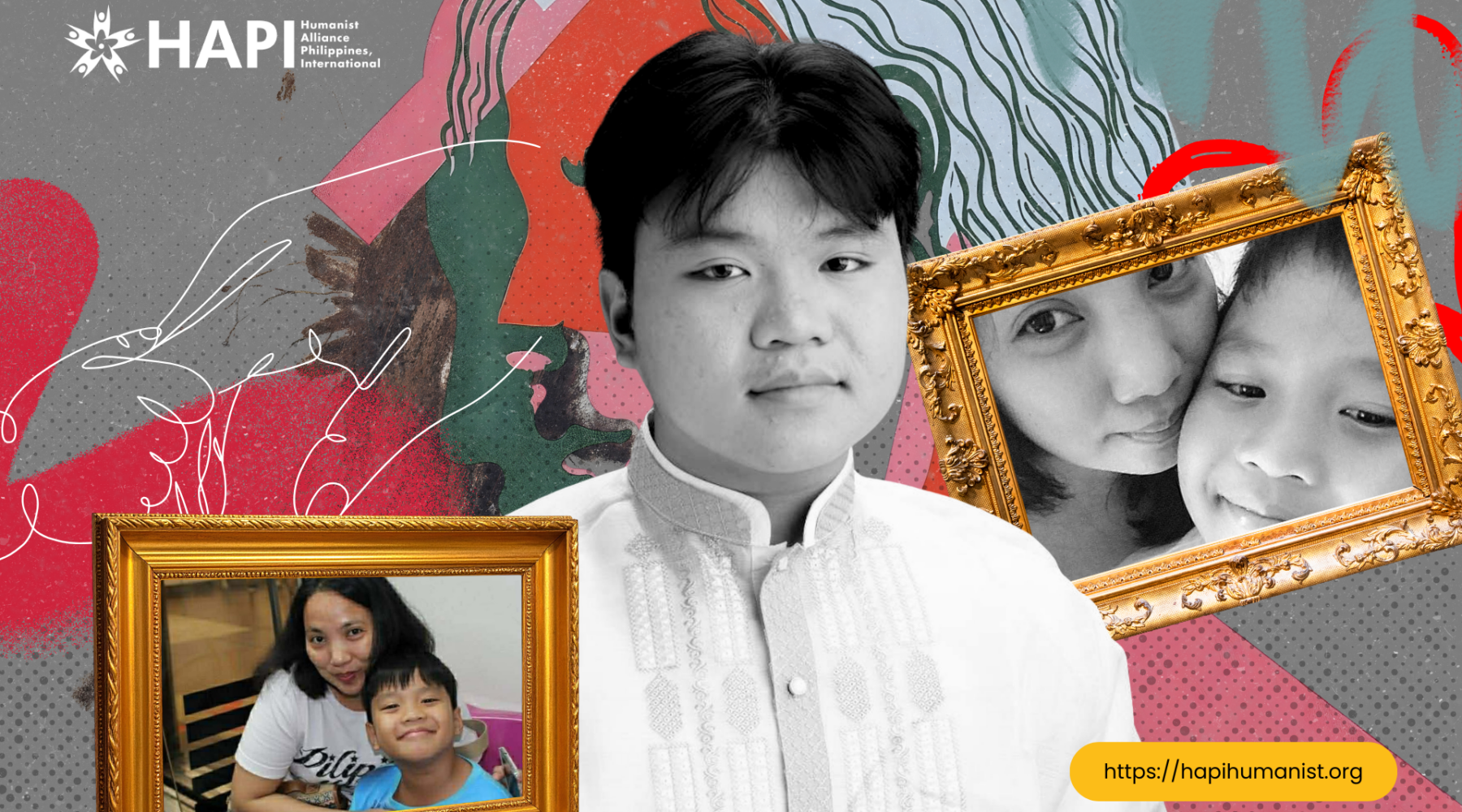
To My Mama, the First Humanist I Met
Remembering Mary Jane Quiming: A Dedicated Humanist, Leader, Mother and Friend.
Remembering Mary Jane Quiming: A Dedicated Humanist, Leader, Mother and Friend.
I was not raised to bow my head before answers – I was raised to ask better questions.
I have a mother who never handed me a fixed script for life. Instead, she handed me a compass. And it didn’t point to heaven or hell. It pointed to humanity. In our home, morality wasn’t something suspended in the sky waiting to judge us. It showed up in ordinary moments: in how we helped kids who couldn’t afford school supplies, in how we organized events to cater those in need, in how openly we talked about our own beliefs, and in whether we stayed silent or spoke up when something is unjust.
She’s a humanist, but she never forced me to become one. There was no pressure, no indoctrination. Frankly, when she was working abroad, she didn’t even pressure me into becoming like her; she told me that I should freely express what I preach. She even laughed when I got slapped during kumpil (Catholic confirmation). But I just grew up breathing in what humanism felt like: an atmosphere of compassion without fear. One of the earliest things she told me still echoes in my head: you can criticize ideas without dehumanizing people.
Shawn Evans Quiming is one of the original HAPI Scholars. His love for biology is matched only by his passion for secular humanism.
We talked about religious doctrines often, especially while scrolling videos of controversial figures using religion as their guide rather than relying on what the people demand. Not to mock them. Not to rebel. Just to examine them. I would ask why certain teachings excluded people or made them feel ashamed. She wouldn’t give me a straight answer. Instead, she’d ask, “Does that teaching reduce someone’s dignity?” That question became my filter for almost everything.
She criticized doctrines she believed were harmful, especially those that justified discrimination or limited autonomy. But she was always clear about one thing: respect is for people; scrutiny is for ideas. That distinction shaped me more than I realized at the time. I learned that disagreement doesn’t have to be cruel. You can stand firm in what you believe and still defend the rights of those who believe differently.
Unlike many of my peers, I wasn’t raised on fear. I wasn’t told to follow rules because I’d be punished or labeled sinful. Instead, my mom would ask me, “Who does this affect?” “What are the consequences?” “Would you accept this if someone did it to you?” Morality, in our house, was about human impact. There was no invisible scoreboard tracking my sins. Just empathy. Just cause and effect.
Over time, goodness stopped being something external. It became internal. I didn’t try to do the right thing because someone was watching. I tried to do the right thing because someone might be hurting. And honestly, that felt heavier-and more meaningful than any threat of damnation.
Growing up like this in a deeply religious environment wasn’t always smooth. There were whispers. Curious looks. The occasional, “So what do you even believe in?” I never felt defensive like I had to prove I wasn’t immoral just because I didn’t frame morality the same way. I love people asking me questions about my belief.
But my mom would always tell me, “Let them ask. Curiosity isn’t an attack. And if it is, respond with clarity, not hostility.” I watched her live that out. When people criticized her, she didn’t lash out. She explained. She listened. She admitted when she didn’t know something. She refused to pretend she had absolute certainty. That kind of intellectual honesty stuck with me.
One moment that really tested what I believed was in university. A professor asked us, “What are your thoughts about conscience?” The room filled with answers about sin, repentance, and divine moral law. I’d grown up hearing those ideas too – that we’re born into a world of sin and need moral systems to correct us.
I don’t see a child as an original sinner. I see a child as an original gift.
When it was my turn, I said something I didn’t even realize had been forming in me for years: I don’t see a child as an original sinner. I see a child as an original gift. Yes, we’re born into a flawed world. But that doesn’t mean we’re flawed in essence.
For me, conscience isn’t installed by religion. It’s awakened by relationship, basically innate. Even before a child understands doctrine, they respond to kindness. I cry when someone else cries. I reach out. I recoil from harm. That’s not theology – that’s humanity.
I’ve been exposed to different religious spaces that teach morality as something we follow to repent for sins against others. And I respect that. I respect the comfort and structure people find in it. But I can’t shake the belief that conscience is innate. It’s that quiet discomfort when we hurt someone. That instinct to say sorry. That urge to repair what we’ve broken. Religion might give language to morality, but I don’t think it creates the capacity for it. Even before belief, there is empathy.
Perhaps the most profound influence my mother had on me was her unwavering commitment to human dignity. When news broke about marginalized communities facing injustice, she did not filter it through doctrine. She filtered it through compassion. “Are people being harmed?” was always the first question. She volunteered. She spoke up. She stood beside those who were misunderstood. Not because it aligned with a divine command, but because helping demanded a response.
That mindset became mine.
Growing up in that environment, I internalized a worldview where identity is secondary to humanity. Before labels of religious, political, cultural, there is a person. Before ideology, there is a beating heart.
Being raised by a humanist mother shaped me in quiet but permanent ways:
There’s something grounding about knowing this life isn’t a rehearsal. That this moment isn’t just preparation for something later. That this messy, fragile, beautiful existence is already the main event. It makes love feel urgent. It makes justice feel necessary. It makes compassion feel like something I can’t postpone.
Some children inherit traditions carved in stone – I inherited questions carved into my conscience.
My mother didn’t hand me certainty. She handed me tools. She taught me how to sit with ambiguity, how to think critically without losing empathy, and how to act responsibly even when it’s uncomfortable. She showed me that I can question doctrines deeply while still defending someone’s right to hold them. That freedom of thought matters – not because it’s commanded from above, but because it belongs to a human mind.
If there’s one thing I carry from her most deeply, it’s this:
Humanism isn’t about rejecting belief. It’s about centering humanity.
And because of her, I’ve come to believe that the measure of a life isn’t how perfectly you followed a script, but how courageously you protected the dignity of others while figuring out your own path.
I am my mother’s son.
Not because I copied her conclusions.
But because I learned her courage to seek my own.
Images provided by Humanist Alliance Philippines, International.